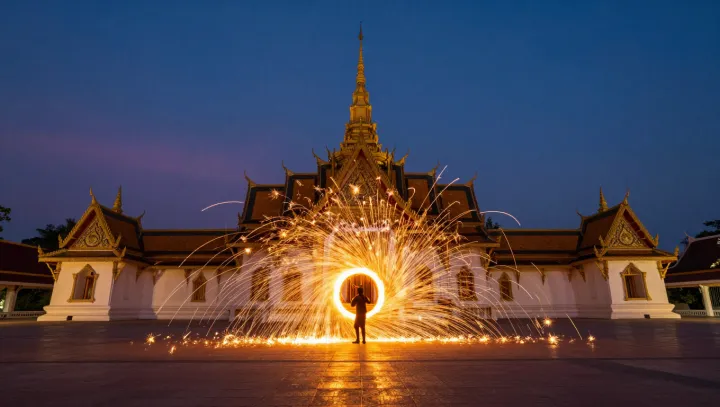
Darkness is not empty; it is unused dynamic range. With long exposure enabled, the sensor waits, and four disciplined camera moves can turn that waiting into handwriting made of photons.
The bold claim is this: you do not need exotic gear to etch razor‑sharp words in midair. You need a locked shutter speed, a fixed aperture, and choreography. First comes the static hold, where the camera remains absolutely still while a point light traces letters; this exploits integration time on the sensor so every stroke accumulates without blur. Then the linear slide, a controlled track move, lets you duplicate or underline shapes by repeating the same gesture as the camera glides sideways, using parallax to separate strokes in space.
The real precision appears with the pivot and the arc. A tripod head acting as a rotation axis turns the camera into a compass, so a tiny twist maps light trails onto different parts of the frame without changing focus distance, relying on constant focal length and fixed focus plane. Add the arc move, a smooth semicircle around the light source, and perspective projection suddenly works in your favor, compressing curved paths into readable characters. Short bursts. Long sweeps. Each move is a simple change of camera position that, under continuous exposure, behaves like a plotter translating pure motion into typography of light.