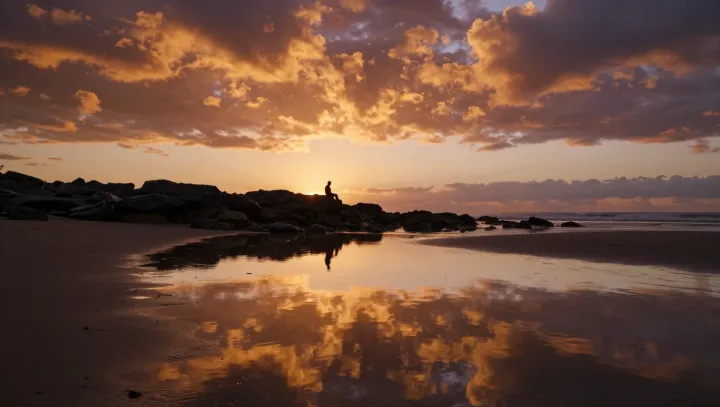
Calm water lies. Over that flat orange band off Laguna Beach, some of the most energetic waves on the planet are already inbound, their force locked in long-period swells born far beyond the visible horizon. What looks like a simple sunset is actually the last frame of a global energy transfer, governed by dispersion, wave interference and the hard geometry of the Pacific basin.
The real driver sits far away. Out in open ocean, intense low-pressure storm systems push on the surface for long stretches of distance and time, injecting momentum into the water column and creating waves with long wavelengths and high group velocity. Short, messy chop dies off first; only the long-period swell, with deep-water orbital motion that can extend well below the surface mixing layer, survives the journey and runs silently beneath passing cargo ships toward the coast.
Deceptive, that still horizon. As swells reach shallower coastal bathymetry near Laguna, wave shoaling and refraction compress their energy into steeper, taller breakers, while the broad swell fronts stay visually smooth until the final seconds before impact. Human eyes read calm from the absence of whitecaps offshore, yet instruments measuring significant wave height and energy flux would show a dense flow of power sliding under the sunset, waiting for the seafloor to force it upright.