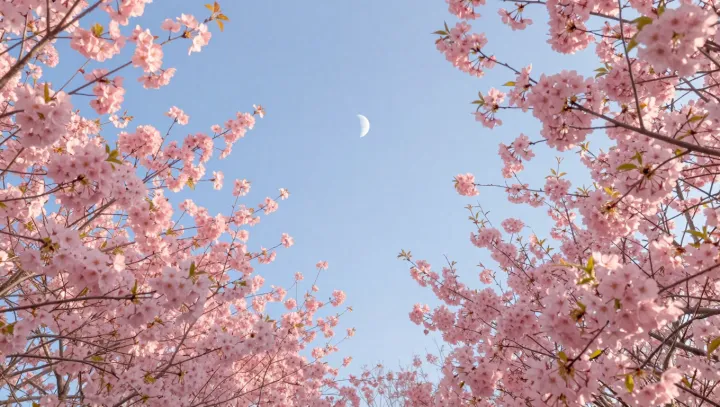
That pale daytime Moon is not rare at all; your eyes are just picky about geometry and glare. When the Sun, Moon, and observer form a wide phase angle, the lunar disk sits far from the Sun on the sky, so its reflected sunlight is not drowned by forward-scattered blue light from air molecules, a process described by Rayleigh scattering.
The surprise is how constrained the setup really is. For the Moon to stand out, its surface brightness must exceed the surrounding sky by a small but fixed contrast margin set by the human visual system, while the line of sight cuts through relatively thin air so optical depth stays modest. That typically happens when the Moon is near first or last quarter, well above the horizon, and at an elongation large enough that you are looking through a dimmer patch of atmosphere.
Most other alignments fail. A near-new Moon lurks too close to the Sun where the sky is brightest, and a nearly full Moon is usually opposite the Sun, glowing at night instead. Only within a narrow range of phase and altitude does the balance between incident solar flux, lunar albedo, and atmospheric scattering fall just right for a white disk to hang in blue daylight, sharp enough for the brain to admit it.