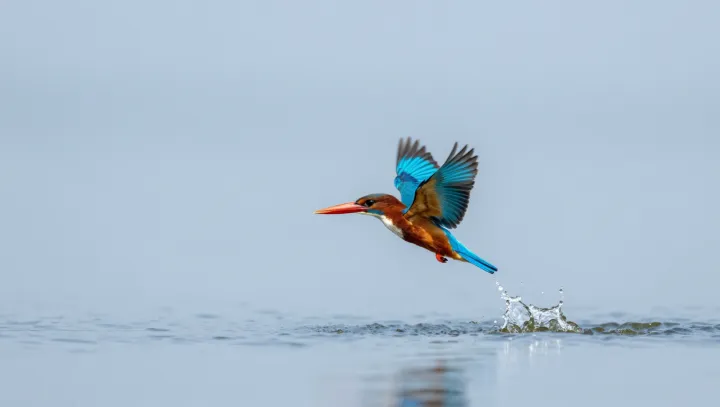
A narrow beak slices the water with almost no splash, and that restraint is the real headline. The common kingfisher, barely larger than a hand, executes dives that behave like living ballistic trajectories, its body pre‑aligned so that gravity and momentum, not muscle corrections, do most of the work.
Such economy is no accident; it is an evolved answer to fluid dynamics. Kingfishers lock onto darting fish using binocular vision and rapid saccades, then couple that targeting to vestibulo‑ocular reflexes that keep the gaze steady while the body pitches forward. Neural circuits time the plunge so that refraction at the air‑water boundary, which normally displaces apparent prey position, is compensated before the bird leaves its perch.
Engineers call this a design manual written in feathers. The bird’s wedge‑shaped head and streamlined contour minimize pressure waves at impact, a natural case study in laminar flow and drag reduction that has informed high‑speed train noses built to cut tunnel booms. Where computer simulations search parameter space, the kingfisher offers a compact, field‑tested prototype that turns hunting physics into transport efficiency.