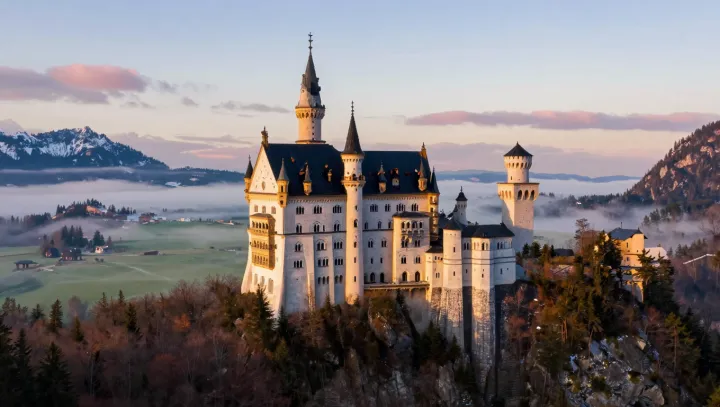
Neuschwanstein did not just inspire Cinderella Castle; it dictated its bones. That steep vertical thrust, the stacked courtyards, the abrupt cliff‑edge drop? They reappear in Florida as if traced with carbon paper.
More than a romantic backdrop, the Bavarian structure functioned as a full‑scale storyboard, and Disney’s designers treated it almost like a working maquette, translating its asymmetrical massing and sightline tricks into a park where forced perspective and crowd circulation are the real sovereigns. Blue spires and pastel stone soften the martial outline, yet the silhouette still follows Neuschwanstein’s rhythm of keep, curtain wall, and needle‑thin turrets, only cleaned up for a camera that never blinks.
The sharper irony is this: Neuschwanstein was conceived as a private, inward‑looking refuge, a half‑finished stage set for one man’s obsessions, yet its scenographic planning and theatrical façades offered Disney a ready‑made operating system for fantasy, proving that an incomplete royal daydream could become the default castle of global childhood.