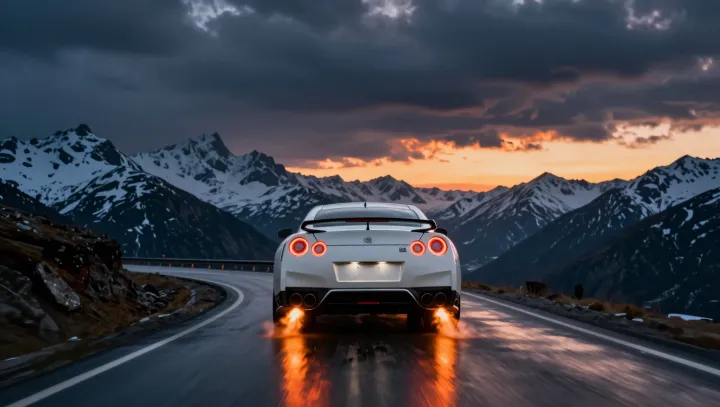
Flames at the tailpipe look like pure waste. They are not. That bright burst is mostly timing and chemistry, not a fuel bonfire gone wrong. In a modern road‑legal sports car, the engine control unit meters fuel with closed‑loop precision using oxygen sensors, then deliberately shifts the air‑fuel ratio and ignition timing only in brief, high‑load moments.
The harsh truth for spectators is this: the engine already spent most of that fuel doing work inside the cylinders. What reaches the exhaust as unburned hydrocarbons is usually a thin remainder, heated by exhaust gas temperatures that can exceed the light‑off threshold of the catalytic converter. When ignition is retarded for power or turbocharger protection, some combustion simply continues in the manifold and tailpipe, where oxygen from a slightly rich or transient mixture lets it flare visibly.
The more interesting story hides in turbo hardware and emissions strategy. To keep a turbocharger spinning, some calibrations use anti‑lag style maps that trade a small efficiency penalty for instant boost, raising exhaust enthalpy and occasionally pushing fuel past the converter’s oxidation capacity. That looks dramatic as blue or orange plumes, yet over a typical drive cycle those short bursts add little to total fuel use, while still staying inside regulatory limits for carbon monoxide and hydrocarbon emissions.