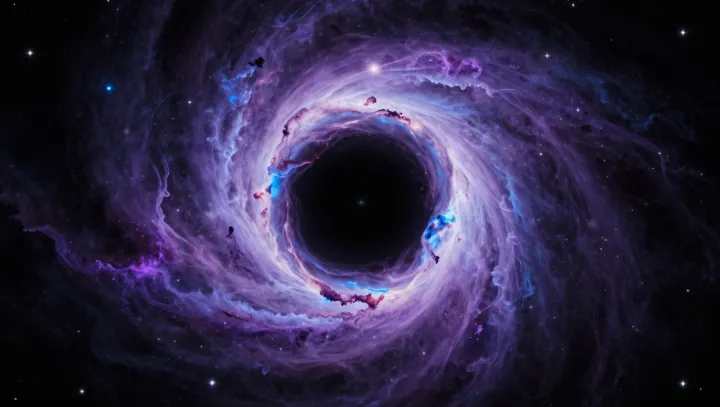
Black holes, often sold as cosmic endpoints, may instead be slow leaks in the universe’s energy budget. From the perspective shaped by Hawking radiation, the event horizon is not a perfect one-way membrane but a quantum stage where particle–antiparticle pairs and vacuum fluctuations give the hole a tiny temperature and an even tinier glow.
More unsettling is the implied bookkeeping. If a black hole radiates like a blackbody, it carries entropy and information content, yet general relativity insists anything crossing the horizon is lost to outside observers, setting up the black hole information paradox and forcing theorists to argue over firewalls, soft hair and holographic encodings. What looks like a featureless shadow from afar may, in quantum field theory on curved spacetime, act as a messy hard drive that slowly rewrites itself into outgoing quanta.
The stark claim is this: given enough cosmic patience, evaporation wins. Stellar remnants shrink, supermassive giants thin out, and in the final stages the shrinking horizon heats up, ending in a brief, intense burst of high-energy emission. No majestic remnant. Just a universe in which even gravity’s deepest wells pay back their energy, one Hawking photon at a time.