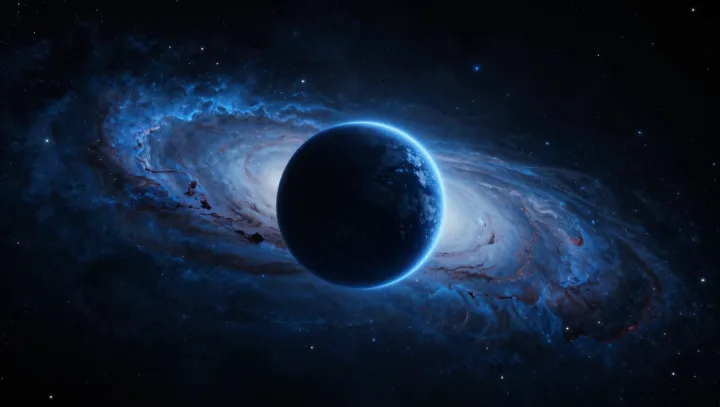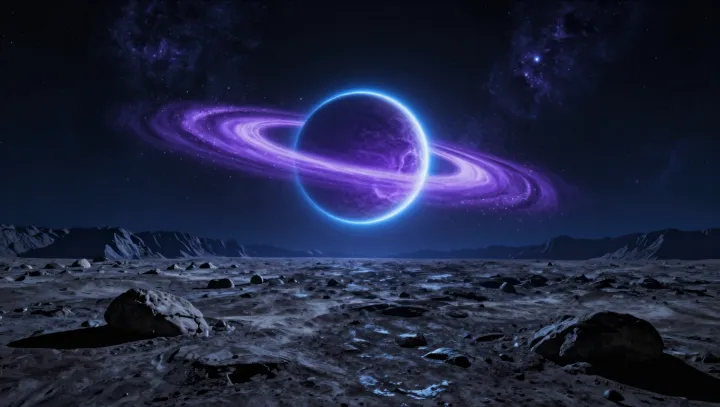
Purple, not blue, is the more honest color for some alien skies. A planet wrapped in a dense photochemical haze could bend starlight so aggressively that its disk would burn violet against the darkness. Think of worlds rich in methane and nitrogen, where intense ultraviolet radiation tears simple molecules apart and recombines them into complex hydrocarbons suspended as aerosol particles high in the atmosphere.
The key is size. Tiny gas molecules favor Rayleigh scattering and shift light toward blue, but slightly larger aerosol particles enter the regime of Mie scattering, where wavelength preferences flatten and subtle absorption features start to matter. Tholin-like particles, known from experiments modeling outer system atmospheres, absorb green and yellow light more efficiently while still scattering red and blue, so the integrated output can skew toward a saturated purple hue when seen at a distance.
This effect would sharpen under a bright, ultraviolet-heavy host star. Strong UV flux accelerates photodissociation, boosts aerosol production, and thickens the haze layer until it dominates the scattering optical depth. Additional processes such as Raman scattering in molecular hydrogen can further reshape the spectrum, nudging photons between colors and enhancing the non-intuitive tint. Against an otherwise ordinary starfield, such a planet would not look exotic because of surface oceans or rings, but because chemistry in the upper atmosphere hijacks the starlight itself.