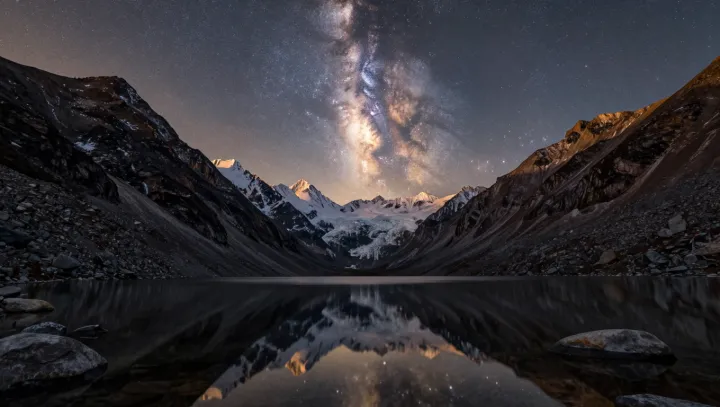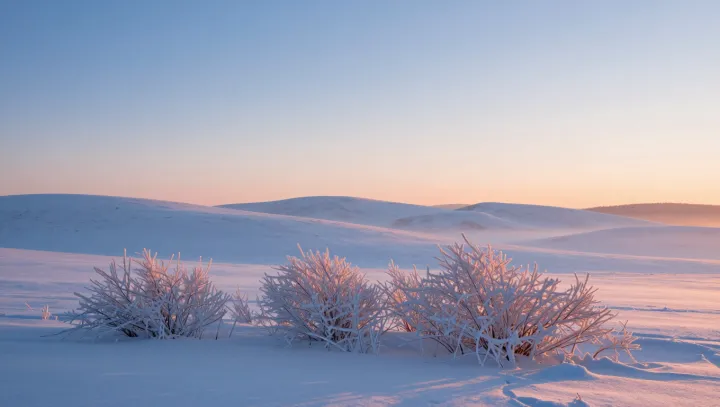
Absolute stillness is a lie that snow tells well. Under that pale dawn glow, each grain is busy, its ice lattice losing molecules to the air through sublimation while neighboring grains quietly gain them back through deposition, a trade that continues as long as water vapor and temperature stay even slightly out of balance.
The sharper the crystal looks to the eye, the more unstable it tends to be. Flat facets expose specific crystallographic planes that favor sublimation, so edges round off and cavities form as molecules escape, driven by gradients in vapor pressure and tiny differences in radiative cooling between shaded hollows and exposed ridges that sit millimeters apart yet live in different thermodynamic niches.
What appears as a smooth white sheet is in fact a shifting mesh of bonds. Grain boundaries migrate, sintering pulls separate crystals into fused clusters, and metamorphism reorganizes pore spaces, all governed by diffusion kinetics and surface energy minimization that turn the snowpack into a slow reactor, constantly editing its own structure without leaving a single visible ripple on the dawn surface.