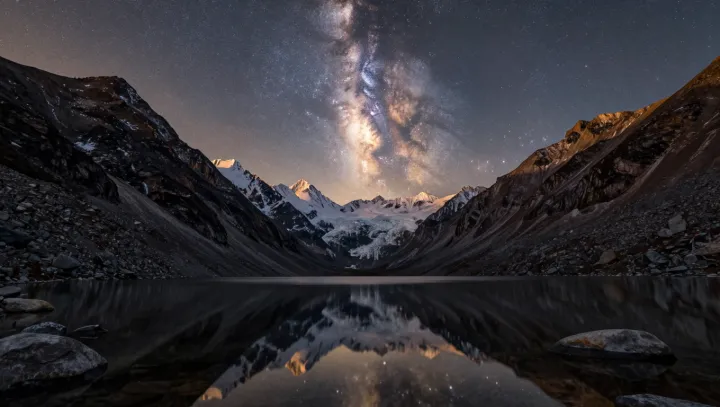
A mountain lake is not magic glass; it simply beats the air above it at one narrow job. Reflecting starlight. While the atmosphere is thick, chaotic and full of aerosols, the water surface is a thin interface where most incident light is either reflected specularly or transmitted with minimal additional scattering.
Key is this imbalance between two kinds of mess. In the air column, Rayleigh scattering by gas molecules and Mie scattering by dust and droplets redirect photons over large solid angles, so the Milky Way loses contrast and sharpness before it reaches the observer. At the lake surface, by contrast, Fresnel reflection dominates: for shallow viewing angles, a large fraction of incoming light is reflected coherently, preserving angular information like a mirror.
Stillness then becomes the quiet accomplice. When wind is low and waves shrink to long, gentle ripples, the surface roughness remains small compared with the angular scale of the Milky Way structures, so each patch of water behaves as a locally flat mirror. Turbulence in the air continues to distort wavefronts, but those aberrations are already baked into the downcoming light; the lake does not add much extra blur. It simply redirects that corrupted, yet still richly structured, celestial image toward the camera with surprisingly little additional damage.