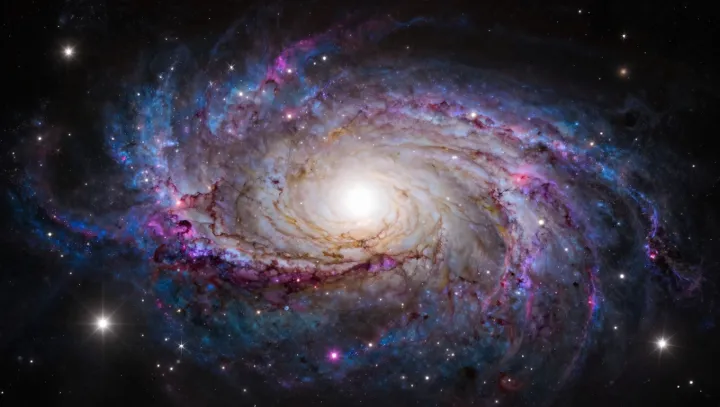
A spiral galaxy tells its story backward. Its glaring core looks young to the eye, yet it holds the oldest stars, packed into a dense spheroid where star formation shut down long ago. Around it, the arms and their ragged dust lanes mark later chapters, written in gas, shock fronts and disrupted orbits.
Astronomers insist this is not guesswork; the light itself confesses. Short, punchy blue wavelengths flag hot, massive stars that live fast and die, while redder, cooler spectra trace long‑lived, low‑mass populations. By fitting stellar population synthesis models to these spectra, and by measuring metallicity gradients across the disk, researchers order stellar generations the way a geologist orders sedimentary layers. Dust lanes, mapped in absorption and in infrared emission, reveal where gas collapsed recently, and where feedback from supernovae carved cavities and stalled new birth.
Even the motion betrays history. Rotation curves and velocity dispersion fields, extracted from integral field spectroscopy, expose past mergers and bar instabilities that drove gas inward and triggered central starbursts. Dark lanes draped along these dynamical structures record where cold molecular clouds once stacked up, then fragmented under self‑gravity. Piece by piece, brightness, color, chemistry and kinematics lock into a consistent chronology, allowing astronomers to reconstruct billions of years of star formation they can never watch unfold in real time.