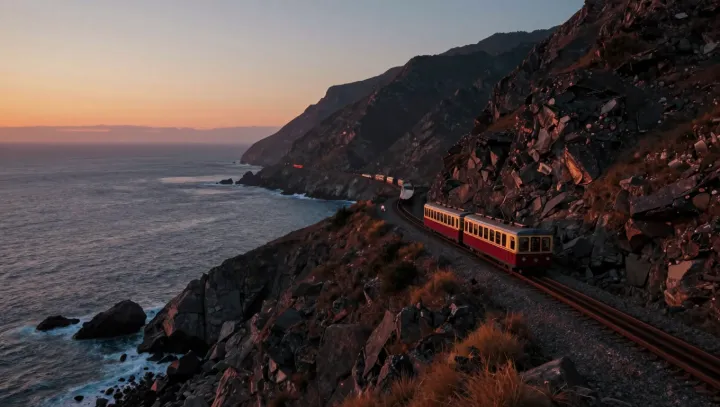
Spray on the windows is not romance; it is a design constraint measured in millimeters and kilonewtons. Track that close to surf survives only because engineers treat every cliff as hostile structure, not scenery, and then rebuild it from the inside out.
First comes the verdict on the rock mass. Short cores. Lab tests. A geotechnical model that decides whether the cliff behaves like cracked concrete or like a loose pile of gravel. On that judgment hangs the choice between bored piles drilled deep into competent strata and a continuous concrete retaining wall keyed into bedrock. Rails sit on ballast and sleepers as usual, yet below them the foundation behaves more like a bridge abutment than a simple embankment.
Sheer faces do not get trust; they get hardware. Engineers drive rock bolts and post-tensioned anchors into the cliff, then cover it with shotcrete and steel mesh so loose blocks cannot start a chain reaction. Wave energy is handled as a separate enemy. Armor stone revetments, recurved seawalls and stilling basins reshape hydraulic loading so that peak impact and uplift undercutting never reach the track support zone. Drainage is the quiet hero. Perforated pipes, weep holes and filter layers relieve pore-water pressure that would otherwise turn the cliff into a slow landslide. Instrumentation closes the loop, with inclinometers and strain gauges feeding data that can trigger speed limits or emergency works long before passengers see anything except white water below.