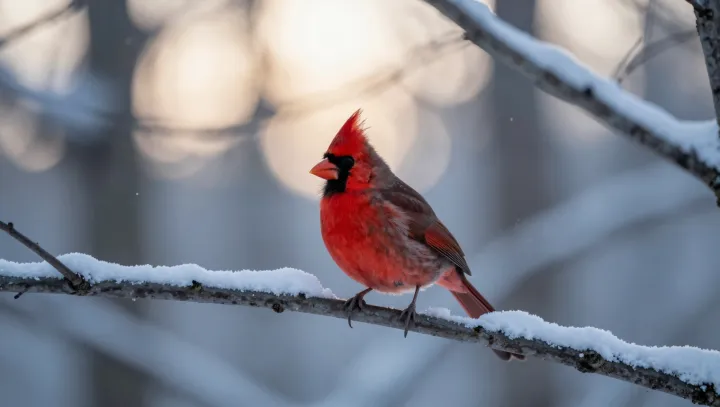
That bright dot on a bare branch is not fragile at all. The cardinal sits like a small furnace, its survival built on physics and anatomy rather than luck or mercy from the weather. Air, not feather thickness, does most of the work. Each feather can lift and rotate; raised plumage traps a deep layer of still air over skin, forming an insulating boundary layer that cuts conductive and convective heat loss to the surrounding cold.
More impressive is the way heat is routed. The bird’s legs look exposed, yet a countercurrent heat exchange system in the arteries and veins of the legs strips warmth from outgoing blood and recycles it back toward the core, keeping the torso near a stable body temperature while allowing extremities to run cold. This vascular trick, paired with vasoconstriction in peripheral tissues, slashes energy wasted on feet and shins gripping ice.
Energy, not courage, covers the final gap. A cardinal carries fat reserves like a living fuel tank and burns them through elevated basal metabolic rate and controlled shivering thermogenesis in skeletal muscle, turning food into constant internal heat. Tucked into a wind shadow, head buried in back feathers, it becomes a compact, red engine on a stick, running just hard enough to avoid turning into a tiny sculpture of ice.