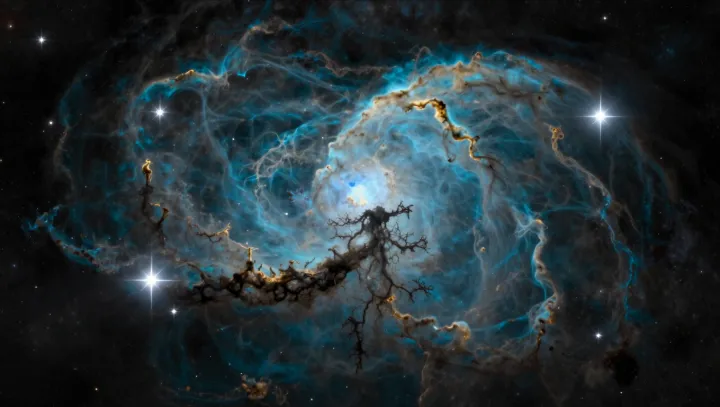
The sky is lying to your eyes. That ghostly nebula you barely glimpse is already pouring structured light toward you, yet your vision discards almost all of it because biological optics are built for survival, not for honesty about the night.
Human sight is ruthless. It favors motion and contrast, while the retina’s rod and cone cells saturate quickly and reset fast, so a tiny photon flux from ionized hydrogen or oxygen barely dents the visual cortex. Charge‑coupled devices and CMOS arrays, by contrast, are hoarders: each pixel well integrates photons over long exposure, accumulating signal where your retina keeps flushing the buffer. What felt like emptiness becomes a measurable gradient once the sensor has quietly counted millions of arrivals.
The blue spectacle is not some cosmetic lie; it is a translation choice. Raw astrophotography data sit in a linear dynamic range the brain never sees, so image processing stretches that range with histogram equalization and gamma correction, dragging whisper‑level emission lines into midtones and assigning specific wavelengths to blue channels. Oxygen‑III filters isolate lines near the blue‑green region and, when mapped aggressively, make filaments blaze while stars are tamed by non‑linear curves. What began as almost nothing to the naked eye ends up as a precise, if stylized, map of where the photons actually went.