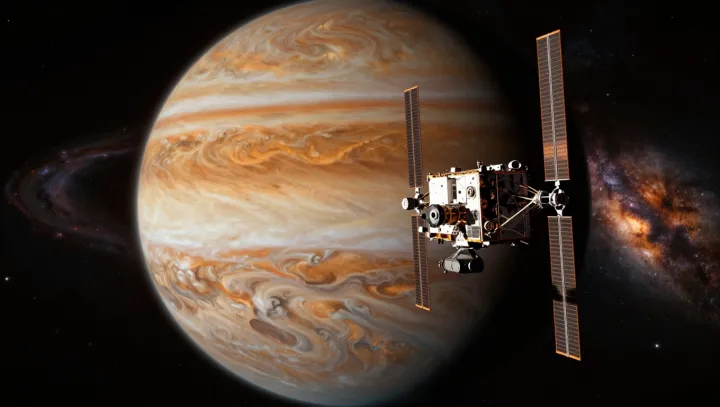
Gravity is not an enemy here. It is the quiet architect that locks a spacecraft into a tight polar orbit, so close that the craft skims just above a gas giant’s upper haze while never touching its crushing clouds. No thruster panic. No last‑second swerves.
The trick is simple in idea, harsh in execution. Mission designers freeze the flight path in advance using celestial mechanics and the two‑body problem, shaping a polar trajectory that repeatedly dives near the planet at periapsis, then swings far out at apoapsis to cool off from radiation and heat. Short passes, fast speed. Each swoop lets instruments sweep across belts and vortices, turning orbital velocity into a scanning tool rather than a hazard to flee.
Storm mapping then becomes a remote operation, not a stunt flight. Microwave radiometers probe deep convection layers; spectrometers dissect cloud chemistry; synthetic aperture radar or limb sounding tracks vertical wind shear without dipping into it. The gas giant’s magnetosphere, while brutal, is treated as a known field in a Hamiltonian system, with radiation belts threaded between carefully chosen paths. Gravity stays constant, predictable, almost boring. The drama is left to the storms below.