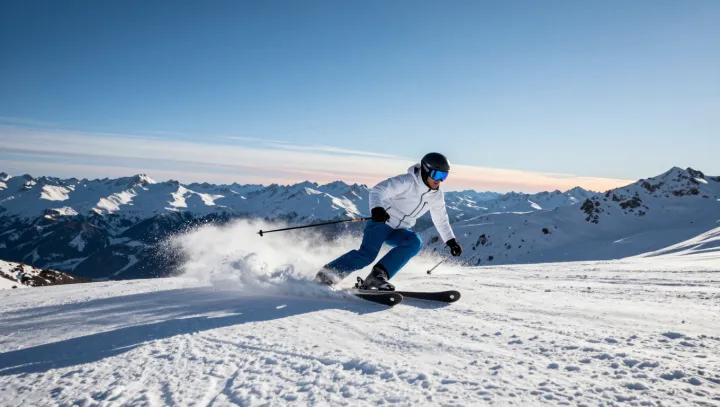
Snow hides a brutal truth. On steep, hardpack slopes a ski shifted just 2–3 degrees can jump from locked grip to a smear of sliding ice under load. That razor margin, shaped by friction coefficients and shear stress in the top snow layer, is exactly what expert skiers seek out rather than avoid.
They want consequence baked into every micro-mistake. When edge angle is so sensitive, biomechanics and muscle memory stop being theory and become instant feedback, as pressure distribution under the boot feeds directly into whether the ski carves a clean arc or detonates into a skid. High edge angles load the ski like a bent beam, increasing normal force and friction; a few degrees flatter, and centripetal force overwhelms grip, sending thousands of tons of moving snow and rider into lateral motion.
This is not a search for comfort; it is a search for signal. In that narrow angular window, balance, proprioception, and dynamic stability are amplified because the system sits near a threshold, a kind of controlled bifurcation where small input swings trigger starkly different outcomes. The slope becomes a live instrument for testing edge sharpness, sidecut geometry, and the skier’s neuromuscular control, turning each turn into a precise experiment in how close a human can ride to failure without crossing it.