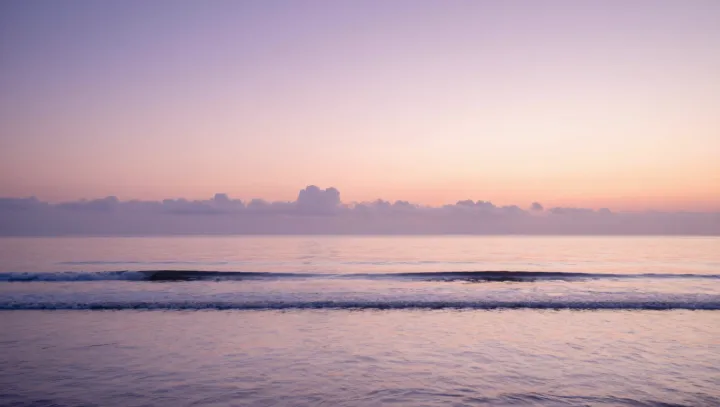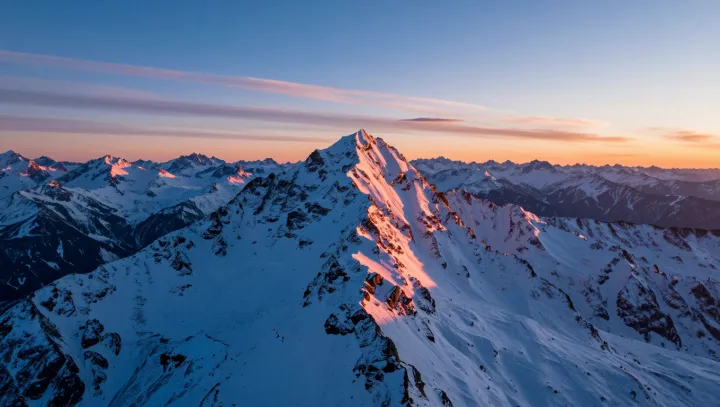
Color lies. So does that pink snow. The surface on those high ridges does not blush or warm; what changes is the column of air between Sun and summit, stretched to extra kilometers by the low angle of dawn.
At that angle, physics gets picky. Rayleigh scattering and Mie scattering strip out much of the shorter wavelength radiation, the blues and violets that usually dominate midday light, because those photons interact more strongly with gas molecules and aerosols along the extended path. What survives the journey is a spectrum skewed toward longer wavelengths, rich in reds and oranges, which the snow reflects efficiently thanks to its high albedo and granular ice structure.
So the mountains do not ignite; the filter thickens. As the Sun climbs higher, the optical path shortens, scattering becomes less selective, and the incoming spectrum flattens toward white. The same snow that briefly burned with warm color slides back into stark brightness, while the real drama remains suspended in the unseen chemistry and geometry of the air.