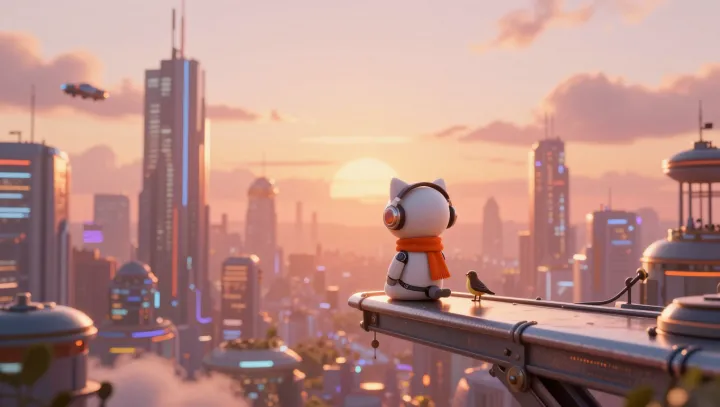
Blinding light makes this tiny cat‑eared robot more vulnerable than any bird. At sunset, a sky full of reflective car hulls, glass canopies and exhaust haze turns the air into a lethal mirror maze, where standard silicon imagers saturate and lose contrast just when traffic density peaks and collision margins shrink to centimeters.
The harsh truth is simple. Birds cheat with biology. Their retinas combine high dynamic range photoreceptors, rapid saccades and parallel processing in the optic tectum, letting them track motion against the sun without stalling mid‑flight, while a compact drone camera, limited by rolling shutter and low dynamic range, whites out under the same glare and turns every brake light and wing edge into an indistinct flare. To survive in multilane aerial corridors, the robot must fuse event‑based cameras, which log microsecond‑scale luminance changes, with neuromorphic sensors that mimic spike‑based neural coding, so it can extract motion vectors and object boundaries even as sunlight strobes between skyscrapers.
More demanding still is height. Thin air, rapid vertical shifts and crosswinds force the machine to read parallax, optical flow and stereo disparity faster than a swallow, because flying cars will not slow down for a hesitant micro‑pilot. Here, high dynamic range vision is not a feature. It is life support, allowing the cat‑eared frame to judge distance off polished fuselages, detect rotor wash in dust plumes and commit to split‑second lane changes while the horizon burns orange and the traffic algorithm leaves no room for second guesses.