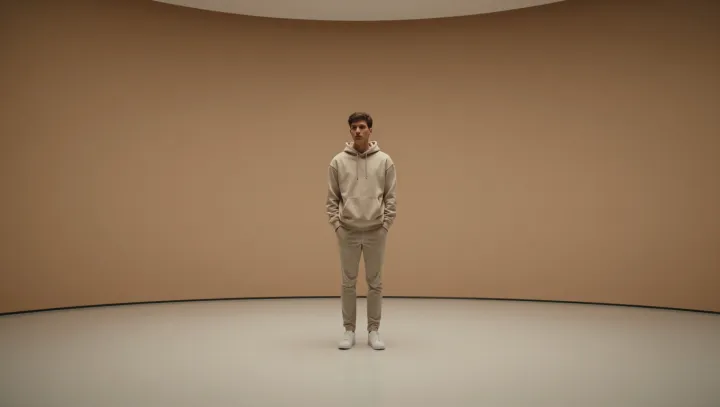
A cream hoodie does more engineering than most gym sessions. Soft color on the torso lifts the eye, because lighter value areas are processed faster by the visual cortex, concentrating attention on the upper body and away from hips or thighs. When the hoodie is slightly boxy rather than clingy, it creates a controlled volume that reads as intentional structure, not bulk, shifting perception of where the body seems to start and end.
The real trick sits in the contrast between that hoodie and tapered beige pants. Proportion theory says narrower shapes appear longer, so a tapered leg, combined with a mid-value beige that neither shouts nor disappears, compresses the apparent width of the lower half while stretching its vertical line. Add light sneakers that almost match the pants and you erase a hard hem boundary, a kind of optical gradient that functions like a low-key color-block experiment in applied Gestalt psychology.
Put bluntly, this outfit hacks human vision, not your fat cells. Color value, luminance contrast and shape ratios do the heavy lifting, exploiting how figure–ground segregation and vertical–horizontal illusion bias our reading of size. Your mass stays identical, yet the top feels lighter and lifted, the legs cleaner and longer, because the eye has been quietly coached to weigh you differently.