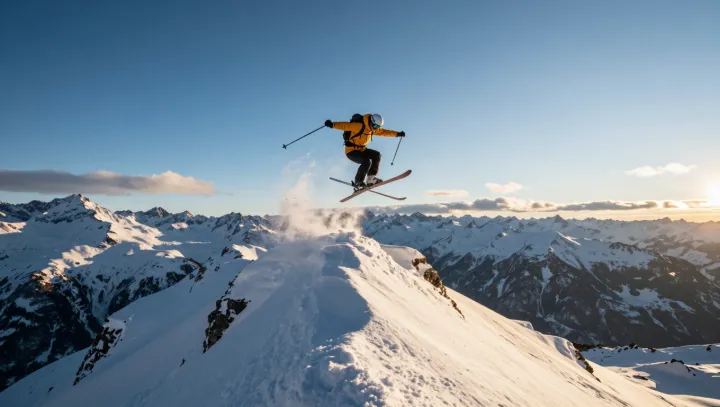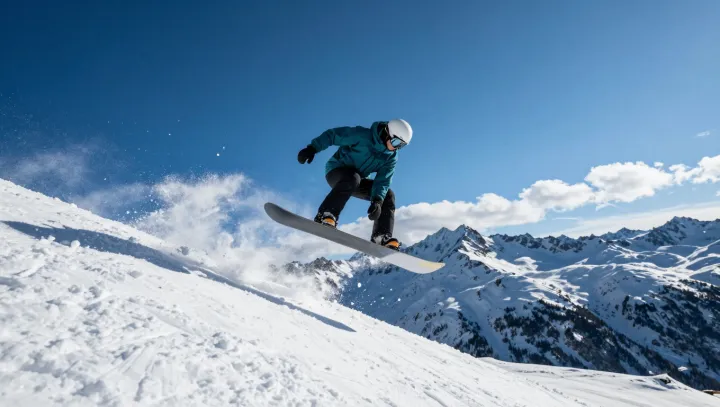
A narrow snow spine behaves less like a hill and more like a low orbit. Edges bite into ice, the rider’s center of mass hanging just inside an invisible fall line the way a satellite hangs inside its path around a planet, both systems ruled by the same trade between gravitational pull and sideways speed.
The bold claim is this: a stable landing starts long before takeoff, inside how the rider stores angular momentum. As the board carves across the ridge, friction and centripetal force set the launch direction, while the rider winds up rotation by pulling arms and knees, turning the body into a flywheel that conserves angular momentum once airborne, just as an orbiting craft preserves its velocity vector when engines cut out.
The counterintuitive part is that control comes from doing less midair, not more. After the board leaves the lip, only gravity, inertia and a few tiny torque inputs remain; a slight arm move shifts the moment of inertia, letting the rider speed or slow spin without changing the total angular momentum, so the board squares to the slope normal just as the base meets snow, echoing how attitude thrusters trim a satellite’s orientation without touching its orbital path.