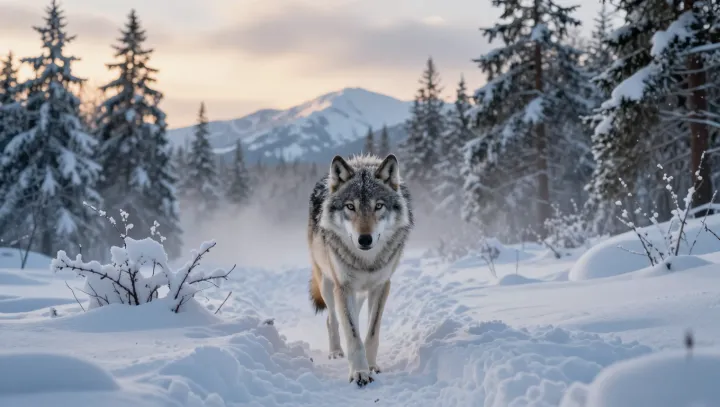
Snow resting on a gray wolf’s back is not a poetic image; it is proof of ruthless efficiency. The animal is so well insulated that body heat barely reaches the surface, allowing flakes to pile up like frost on a sealed thermos. Warmth leaks slowly, not dramatically.
What looks like simple fur is a layered system, and that hierarchy matters more than sheer thickness. Closest to the skin lies dense underfur, a mat of fine fibers that traps a layer of still air; that trapped air is the real insulator, limiting heat transfer by convection and conduction. Above it stand longer guard hairs, glossy and stiff, that shed wind and liquid water while creating a rough outer shell. Between these tiers, micro pockets of air form a boundary layer that behaves like vacuum flask walls, keeping the core near a stable temperature even when ambient air plunges far below freezing.
The wolf’s body then exploits this structure with precise control. Peripheral vasoconstriction reduces blood flow to the skin, lowering surface temperature so sharply that the outer coat hovers only slightly above the surrounding air. That is why snow does not melt; the heat budget is guarded for vital organs and working muscles. Add seasonal molting, which adjusts fiber density and length, and the result is not just a thick coat but a responsive insulation system that treats every blizzard as a manageable engineering problem.