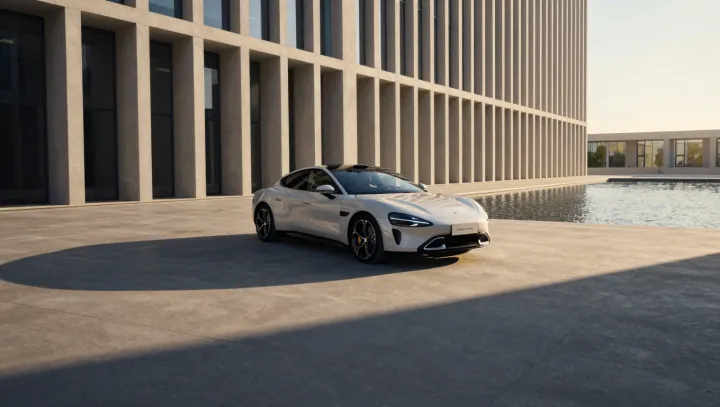
Concrete does the Lamborghini a favor that a city street never will. Hard angles and blank surfaces strip the scene of competing signals, so the car is not just present; it is the only visual event worth processing. Against matte gray, the white body hits the retina with a sharp luminance jump that activates edge detection in the visual cortex with almost laboratory clarity.
More authority comes from the low sun. At that angle, light stretches shadows and boosts local contrast, exaggerating every crease in the bodywork and every contour of the concrete. High dynamic range between highlight and shadow drives stronger responses in photoreceptors and in contrast-sensitive neurons, turning the car into a high-gain stimulus. A busy street, packed with signage, colors and motion, triggers what psychologists call selective attention: the brain down-regulates most of it as noise. The Lamborghini then becomes just one more object inside visual clutter, its outline fragmented by overlapping forms and mixed color fields.
So the quieter the set, the louder the car reads. Sparse geometry, strong directional light and a single bright subject exploit basic mechanisms of figure-ground segregation and contrast adaptation, giving that white Lamborghini the kind of dominance no crowd of neon ads can buy.