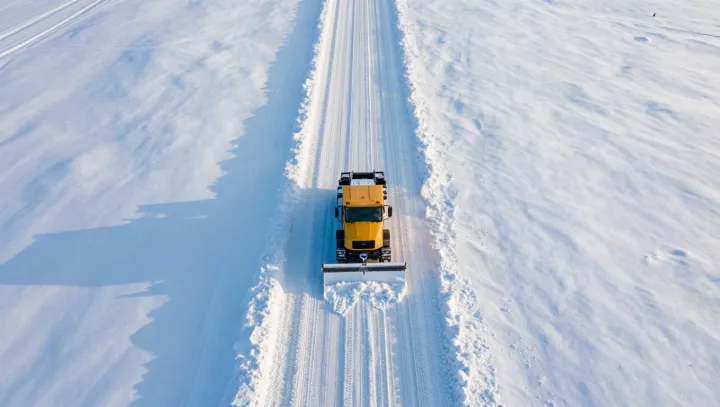
A steel blade not speed is the main brute in a snowstorm. Moving at tens of kilometers per hour, the plow carries enough momentum that each kilogram of truck and hardware becomes a negotiator with packed snow, transferring linear momentum into a sideways surge that sends tons of crystals sliding off the roadway.
Counterintuitively, the blade wins not by impact but by pressure. Its contact edge concentrates the vehicle’s weight into a narrow strip, so the local pressure in front of the moldboard exceeds the compressive strength of dense snow, forcing it to yield and shear. That shearing flow creates a moving wedge, much like a granular fluid obeying basic continuum mechanics, which allows heavy windrows to form with only modest forward speed.
The unexpectedly smooth tracks are a friction story. As the blade scrapes, it generates heat through kinetic friction and compressive work, briefly raising temperature at the interface enough to create a microscopic film of meltwater that lubricates then refreezes. Combined with the geometric profile of the cutting edge and the moldboard, which functions as a long mechanical advantage ramp, the result is a planed surface where larger aggregates are shaved off and fine particles are compacted into a dense, low-roughness layer that can rival some unpaved summer roads.