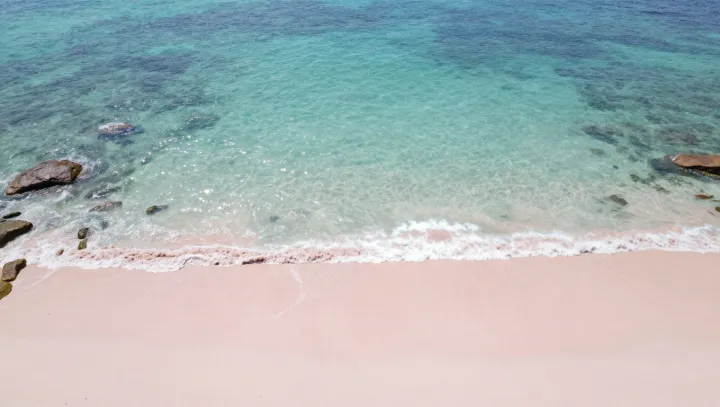
Pink beaches are less whimsy than physics. Along certain tropical coasts, the shore really does blush because the sand is loaded with broken shells of tiny marine organisms, especially foraminifera, mixed with pale quartz and coral debris that together shift how incoming sunlight is filtered and reflected at the waterline.
The key trick is selective survival. Heavy, iron‑oxide grains or dark volcanic minerals settle offshore, while more buoyant calcium carbonate chips from coral skeletons and foraminifera tests are sorted by wave energy and longshore drift, so the strand becomes enriched in pale fragments whose red pigments and internal microstructures bias reflection toward pink wavelengths.
What looks like a color filter at the shoreline is really optics and grain size working in tandem. The water remains a gentle turquoise because short blue and green wavelengths dominate through Rayleigh scattering in the water column and reduced absorption, yet the wet surface layer of shell‑rich sand reflects longer red components, so each receding wave briefly exposes a split spectrum right under your feet.
The effect is amplified by texture. Coarse bioclastic grains create strong Mie scattering at low angles, making the dry upper beach appear rosier, while the saturated zone, where capillary water films form around each particle, deepens contrast between the pinkish substrate and the overlying blue‑green surf, turning a casual shoreline walk into an unintentional field experiment in coastal optics.