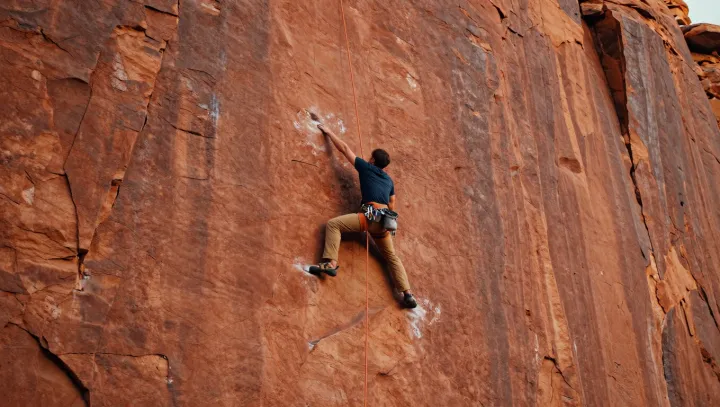
Gravity, not bravado, decides how elite climbers move. On steep rock, the legs do the heavy lifting because quadriceps and gluteal muscles can generate far more power and endure repeated contractions with lower metabolic cost than the smaller flexors of the forearm. Arms are downgraded to hooks, managing balance and subtle grip changes while the feet drive upward like pistons against tiny edges.
Counterintuitive to gym culture is the idea that a quiet arm often signals mastery. By placing weight directly over footholds and keeping the center of mass close to the wall, climbers increase normal force and friction, letting rubber and geometry, not biceps, carry the load. Precise edging and smearing allow micro‑adjustments so that skeletal alignment, from ankle through hip to spine, creates near‑static positions instead of exhausting isometric pulls.
Equally subversive is how technique can neutralize a stronger rival. Coaches talk in terms of torque, joint angles and force vectors, not personal records on a pull‑up bar. When hips are rotated into the wall and feet are staggered, the body forms efficient levers that convert small pushes through the toes into upward motion. On hard routes, this bias toward lower‑body propulsion turns the wall into a problem of geometry and pressure, not a contest of raw arm strength.