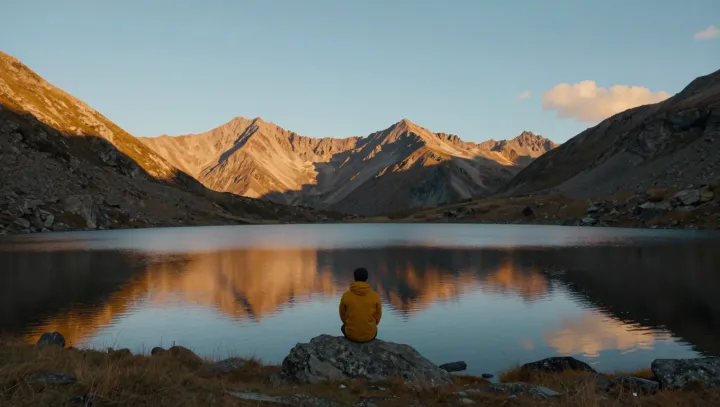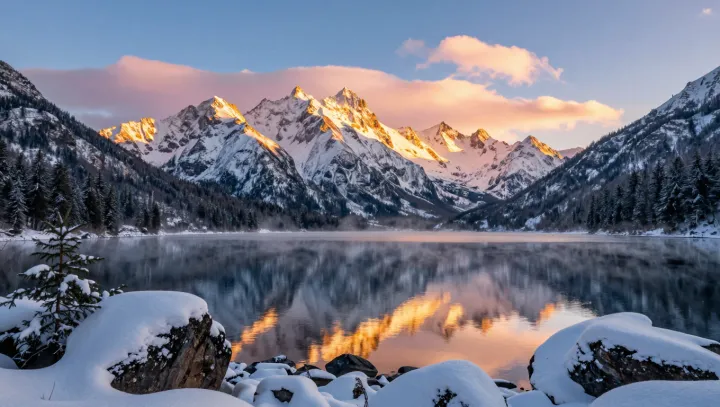
The lake is not copying the mountains; it is editing them. At dawn, low-angle sunlight scatters through the atmosphere, boosting shorter wavelengths and creating a gradient of polarized light that the water surface selectively sends toward your eyes, while the rock and snow simply scatter that same light in every direction with far less discipline.
What seems like extra detail is really better curation. A smooth surface behaves as a specular reflector, compressing the dynamic range of the bright snow and dark rock into a tighter band that the retina and visual cortex can handle more efficiently, so micro-contrasts in ridges and cornices stand out instead of being buried inside glare or deep shadow from direct viewing lines.
Color gets an unfair boost as well. The water column absorbs and filters parts of the spectrum, then mixes reflected skylight with the mountain image, so the reflected scene carries subtle shifts in chromaticity that look saturated yet still believable, while atmospheric haze in the direct view desaturates and veils distant slopes through Mie scattering and Rayleigh scattering working in tandem.
The final trick is cognitive. Your brain expects the reflection to be special, so it allocates more attention and edge-detection effort to that framed patch of water, turning a simple Fresnel reflection into a scene that feels more vivid than the silent, unedited peaks above it.