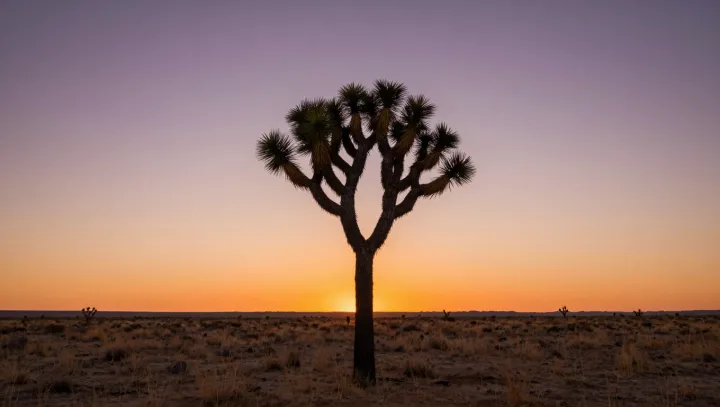
Survival here is less miracle than engineering stripped to bare minimum. Around each Joshua tree, a web of roots stays close to the surface, fanning out far beyond the reach of its spiky crown, so that even a thin, passing shower is intercepted before it can sink deeper into the sand and escape.
This tree wins by staying small on the inside, not big on the outside. Its root architecture favors lateral spread over depth, maximizing contact with the upper soil horizon where brief pulses of moisture appear, while the succulent tissues in trunk and leaves act as a modest storage reservoir rather than a lush reserve, keeping biomass limited and maintenance costs low.
Metabolically, the strategy is even more austere. The Joshua tree relies on low photosynthetic flux and a reduced respiration rate, and its stomata open cautiously, often exploiting cooler, darker hours to cut evaporative loss; under water stress, growth slows to a crawl, yet tissues remain viable, so that the plant effectively rides out long dry spells without the overhead of rapid turnover.