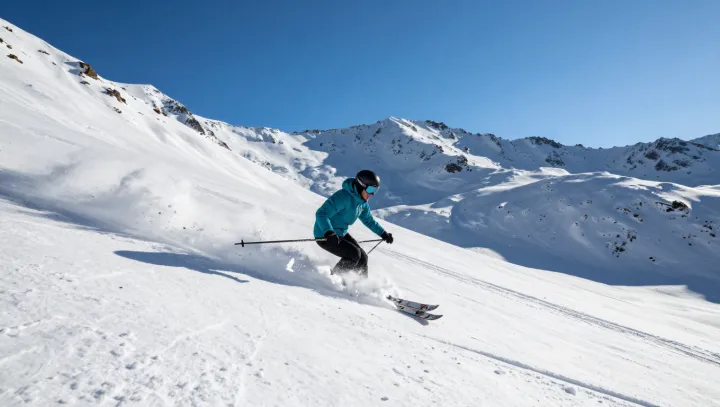
Snow does the talking first, through the tiny vibration that jumps from ski edge to boot. Before any conscious thought, sensory neurons spike, and spinal cord circuits fire predictive patterns that biomechanics labs can model only with dense differential equations. Angle of the tibia, pressure under the forefoot, shear forces at the knee joint: all sampled, updated, and acted on in a fraction of a heartbeat.
The blunt truth is that a skier does not think through Newton’s laws; the body bypasses the slow narrator in the skull. Motor cortex and cerebellum have already compressed years of practice into motor engrams, those stable firing templates that turn impulse into torque around the hip and ankle. What looks like style is actually rapid feedback control, with stretch reflexes and vestibular input adjusting center of mass over a moving base of support while conscious attention lags behind.
Stranger still, the harder the terrain, the less explicit calculation the skier attempts. As speed climbs, cortical involvement drops and subcortical loops take over, operating like a parallel processor that integrates ground reaction forces, angular momentum, and friction coefficients without symbolic math. You grind through one algebra line on paper; their nervous system, tuned by plasticity and fatigue-hardened muscle fibers, is quietly solving the same physics as a living, falling computer.