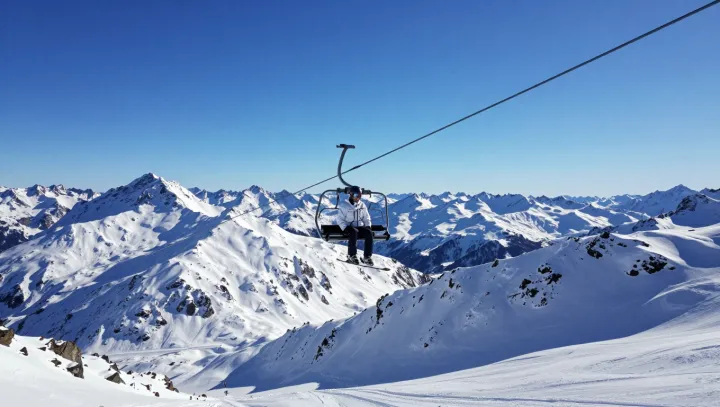
Millimeter accuracy sounds excessive for a ski lift. It is not. A steel haul rope under massive load will hunt for any misalignment, and the system punishes even tiny geometric errors with wear, heat, and noise.
What keeps that rope in line is geometry first, not heroics later. Towers are set by survey to tight tolerances, then crossarms and sheave trains are positioned so the rope’s theoretical catenary passes dead through the center of each groove. The rope wants a smooth potential energy path; engineers give it one with carefully calculated tower spacing, span length, and sag, verified by transit measurements and laser alignment rather than guesswork.
Thermal expansion should wreck this neat picture, yet it does not. A tensioning system, often a counterweight or hydraulic ram, acts as a mechanical buffer that keeps rope tension roughly constant as temperature, ice load, and passenger traffic change. The steel stretches; the carriage moves. That motion is slow but relentless, keeping contact pressures at sheaves within design limits and stopping the rope from hammering the structure during cold snaps.
The quiet scandal is that engineers do not trust static precision alone. They assume drift. Sheave assemblies carry wear indicators, rope position is checked by dial gauges, and non‑destructive testing hunts for strand damage long before it is visible from the chair. Sensors on some systems watch rope sway and derailment risk in real time, feeding operators data on tension and vibration. Alignment, in this world, is not a one‑time achievement but a monitored condition, always a few bad decisions away from failure.