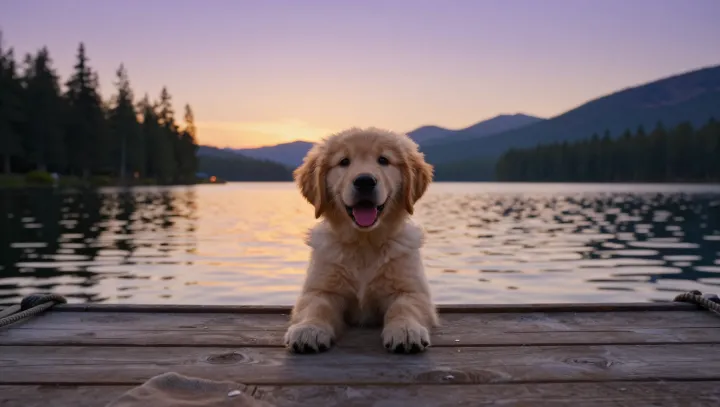
Sunset cheats your brain. Color explodes, detail collapses. A dog beside you lowers its head and, without drama, runs a far richer scan of the same scene.
The basic imbalance is brutal. Human eyes, packed with cones and rods, hit dynamic range limits as intense low-angle light blows out contrast, so retinal photoreceptors and downstream ganglion cells compress information to avoid saturation. A dog’s nose, by contrast, ramps up. Airflow splits between a breathing stream and a dedicated olfactory channel, trapping odor molecules on a convoluted turbinate surface that massively boosts contact area.
What feels mystical is mostly engineering. In the nasal cavity, odorants sort themselves by volatility and solubility, then bind to thousands of distinct olfactory receptor proteins; each pattern activates specific glomeruli in the olfactory bulb, creating a sparse, high-dimensional code. That code lets the dog separate fishy molecules from algae notes, wet soil from decaying leaves, even when the plumes mix above the water like tangled smoke.
Vision, by comparison, is conservative. Under saturated skies, lateral inhibition in retinal circuits protects edges but sacrifices subtle gradients, so reflections on the lake smear into a single band of orange and gold. Olfaction does the opposite: mitral and tufted cells sharpen contrasts between overlapping scents, then ship them to piriform cortex, where combinations are stored almost like layered odor maps.
The unsettling truth is that the dog is not sensing more of the world, just a different slice, with hardware tuned to chaos in the air rather than drama in the sky.