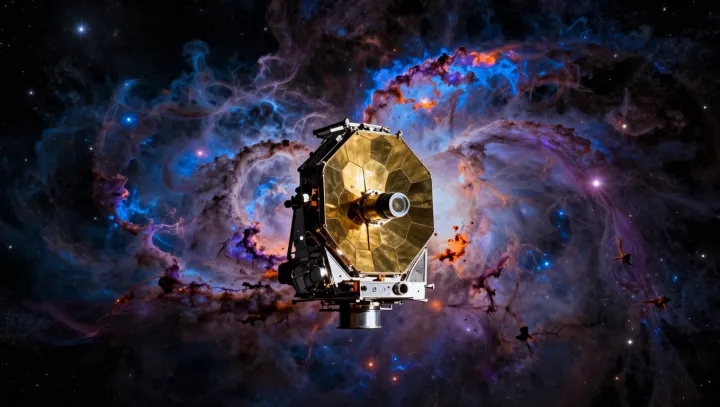
This telescope is not a time machine, yet it behaves like one. Its gold-coated mirrors do nothing mystical; they simply harvest faint infrared photons that have been on the road for an absurdly long journey. Because light propagates at a fixed finite speed, distance in astronomy quietly doubles as a measure of look-back time, turning faraway objects into archival images of the universe itself.
The unsettling part is this: those galaxies are already different, merged, stripped, or dark. What the observatory detects are photons that departed when their stars were younger and their structures more compact, stretched by cosmic expansion into longer wavelengths through cosmological redshift. The gold surface is tuned to reflect infrared, and the cryogenic optics keep thermal noise low, so even those exhausted, stretched photons still carry usable information about stellar populations and interstellar dust.
So the telescope never sees what exists "now" out there; it sees a stacked archive of earlier cosmic states. Each deeper exposure moves the snapshot further back along the light cone, where ionized gas, dark matter halos, and nascent disks were arranging themselves into the systems that no longer look that way. What appears on its detectors is not the present universe, but its delayed self-portrait.