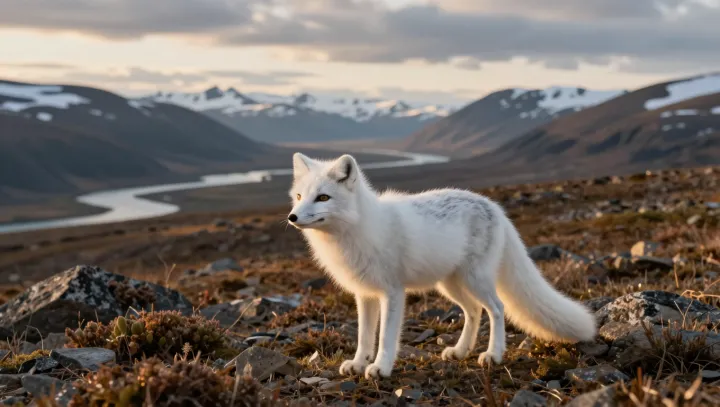
Harsh, not hospitable, best describes open mountain tundra for Arctic foxes. Yet this stripped, windswept ground gives them something dense forest does not: sightlines, early warnings and fast access to prey that moves with the weather. Where snow cover thins and thickens in irregular patches, foxes can track lemmings, ground nesting birds and carrion without the visual clutter that limits predators in taller vegetation, turning apparent exposure into a surveillance advantage.
Their real edge, though, is worn on the body. That pale coat is not decoration. It is one of the highest rated natural insulators measured in any small carnivore, combining air trapping guard hairs with an underfur that rivals purpose built synthetic loft in thermal resistance. Beneath it, a compact body, short muzzle and reduced extremities shrink the surface area to volume ratio, tightening what physiologists describe as the animal’s thermoregulatory envelope and cutting convective heat loss in high wind.
Even the color shift of the coat, from almost white in deep winter to more muted tones when bare rock breaks through, is less about beauty than about signal management. Camouflage reduces detection distance for both prey and larger predators, extending the time window in which a fox can choose to stalk, raid a nest or retreat. In that thin air, on that exposed rock, survival does not come from brute toughness. It comes from treating cold and wind as predictable variables, then letting fur, form and behavior quietly solve the equation.