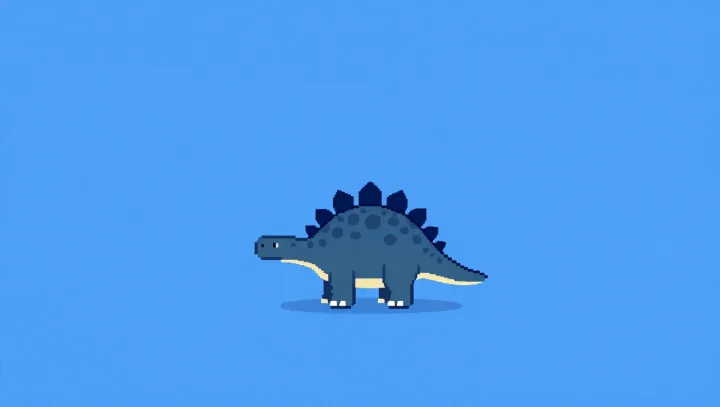
That tiny brain was not a design blunder; it was optimized hardware for a very specific body plan. The lime comparison misleads, because brain volume alone says little about how neural circuits are allocated to balance, muscle control and sensory filtering. Packed into that small cranial cavity were enlarged olfactory regions and a cerebellum sufficient to coordinate slow, predictable gaits rather than agile sprints or complex social games.
More impressive than the skull, though, was the wiring running down the spine. A massive spinal cord enlargement near the hips, once hyped as a “second brain,” was really an expanded plexus of interneurons handling locomotor pattern generation and tail reflexes. Think of it as a distributed control system: central nervous system sets broad parameters, segmental circuits execute repetitive tasks, and muscle spindles plus Golgi tendon organs feed back tension data that fine‑tune every swing of the spiked tail without constant conscious oversight.
The plates added less cognitive load than the popular image suggests. Current work leans toward roles in thermoregulation and visual display, functions governed largely by vascular and developmental biology, not by moment‑to‑moment decision making. Low metabolic rate, heavy armor and a defensive tail meant the animal could afford slow reactions so long as the underlying neuromuscular physiology stayed reliable. Survival here was an engineering problem, and evolution solved it with redundancy, automation and just enough brain, not with excess capacity waiting to be used.