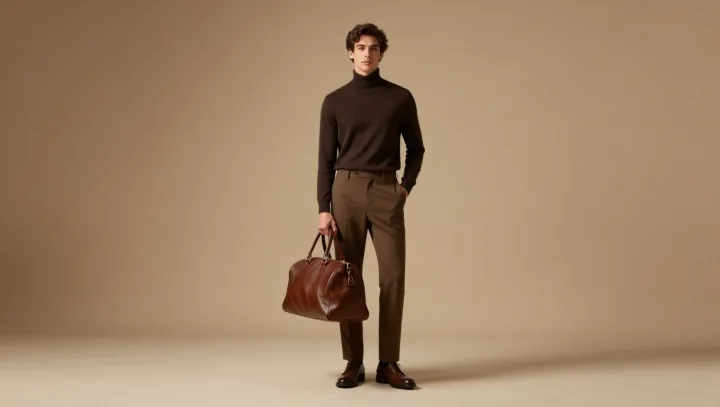
Black fabric does something many power strategies can only promise but never deliver. It amplifies authority while muting the body itself, and the trick sits squarely inside basic optics and neuropsychology. Human vision is a contrast detector first; photoreceptors and later edge‑detection circuits lock onto boundaries where light and dark collide, not on flat, low‑contrast fields of color.
From that bias comes the paradox. A nearly all‑black outfit can read as commanding because it creates a single, coherent silhouette against a lighter environment, turning the wearer into a sharp icon while erasing internal detail. With minimal chromatic variation, the torso, limbs, and even minor posture flaws slip toward perceptual background, as figure–ground segregation pushes the eye to the clean outer contour and the brighter faces, hands, or accessories that punctuate it.
Power, in this visual sense, is less about bulk and more about control over figure assignment. High luminance contrast between the black outline and the surrounding scene lets the brain tag that outline as the organizing figure, yet low internal contrast inside the outfit suppresses texture and volume cues. The result is a psychological hierarchy in which the man’s presence feels large and decisive, while the actual body recedes into a dark, edited shape.