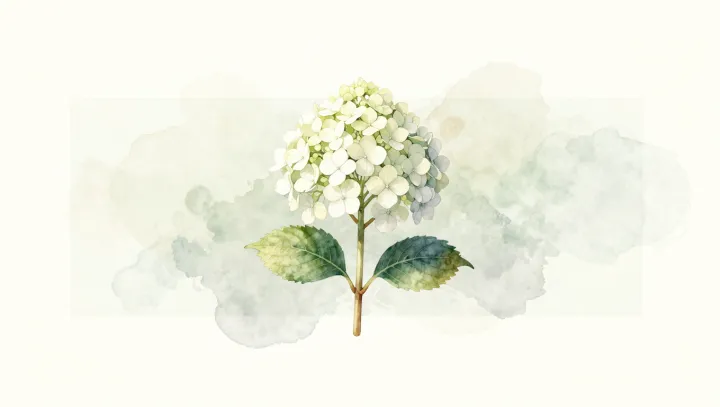
A painted hydrangea is not gentle at all; it is engineered. On wet paper, its soft edge is set by competing flows: pigment particles drift outward by diffusion, while capillary action in the cellulose network drags water along fixed channels, pinning most color near the first contact line instead of letting it run free.
Real petals, for all their translucence, are far less cooperative. Their cells are packed with vacuoles and bounded by cuticle, so water transport is governed by membrane permeability and osmotic pressure, not by open porous media. Pigment molecules sit locked inside cellular compartments, and because the surface is waxy and relatively hydrophobic, free water does not spread in a thin film that could carry visible dye into a halo.
What looks like the same material is, under a microscope, a different universe. Watercolor paint suspends solid pigment in a gum arabic binder; once that binder begins to set, viscosity rises and the contact angle at the wet edge changes, choking off further creep. The petal, in contrast, maintains living turgor pressure and dynamic cytoplasmic streaming, but almost no exposed reservoir of mobile pigment. So the brushmark can feather into a controlled blur, while the bloom on the shrub keeps its outline, each obeying its own quiet set of fluid dynamics and material constraints.