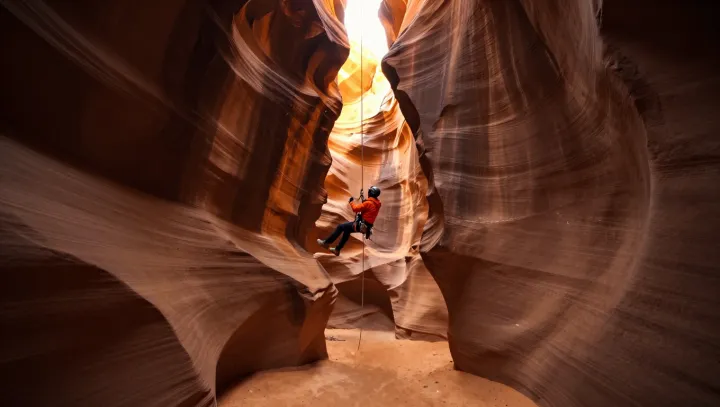
The cliff edge often lies. A body clipped into a modern rope system can sit in a narrow safety envelope, while a hiker strolling unroped along a rim walks one misstep from a total loss event. Gravity is impartial; equipment and procedure are not.
Counterintuitive, yes, but the math backs the wall. A lead or top‑rope climber hangs from a dynamic rope, backed by a harness rated to several kilonewtons, a primary anchor, and often a redundant anchor master point. Add an independent belay device, sometimes a backup knot or second connection, and you get multiple failure layers where a single error rarely proves fatal.
The rim hiker, by contrast, operates as a single point of failure. No back‑up to a loose rock. No friction device to modulate acceleration. No fall factor management: a slip near the edge is effectively a factor‑infinite fall, body straight from standing to impact. A rappeller or climber manages potential energy through controlled descent, converting it gradually to heat in a belay device, keeping peak forces within the rope’s designed elongation range and the anchor’s strength margin.
So the lone figure suspended on the wall, hanging from redundant anchors and a tested harness‑rope chain, can in practice face lower objective risk than the relaxed walker peering over the void with nothing but boot rubber between confidence and catastrophe.