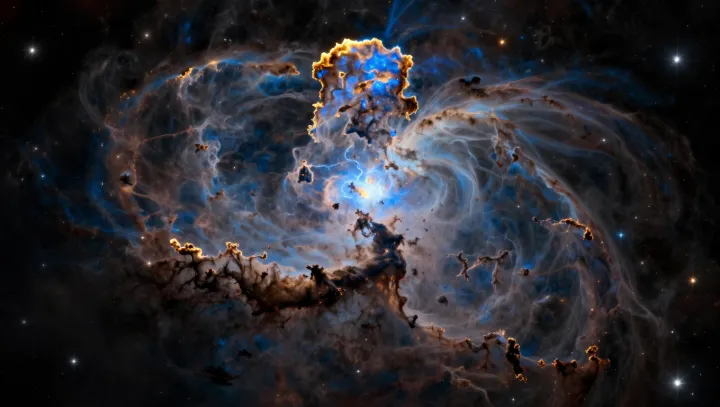
Those gauzy pillars are not fragile at all; they are factories running on patience. Light, wind and shock fronts from nearby massive stars carve dense ridges inside an already cold molecular cloud, compressing hydrogen and dust into narrow columns while blasting away looser gas around them.
What looks almost empty is only empty by human standards. A hand waved through such gas would meet nearly no atoms, yet each cubic centimeter still holds far more particles than the average interstellar medium, and stretched across many trillions of kilometers that slight excess mass adds up to a serious gravitational well. Thermal pressure and magnetic fields fight back, but as radiative cooling lets the gas shed energy, internal motions slow and the Jeans instability takes over: the mass inside a region exceeds what pressure can support, and the pillar begins to contract along its length and into dense knots.
Star birth in these columns is therefore less a sudden ignition than a slow corporate takeover by gravity. Small clumps merge, turbulence decays, and local overdensities become bound cores where protostars form and accrete through rotating accretion disks, while ionizing radiation from earlier massive stars keeps sculpting the outer edges. Seen from afar, the structure looks delicate. In the physics, it is a drawn‑out struggle between pressure and self‑gravity, with gravity winning just often enough to light new suns.