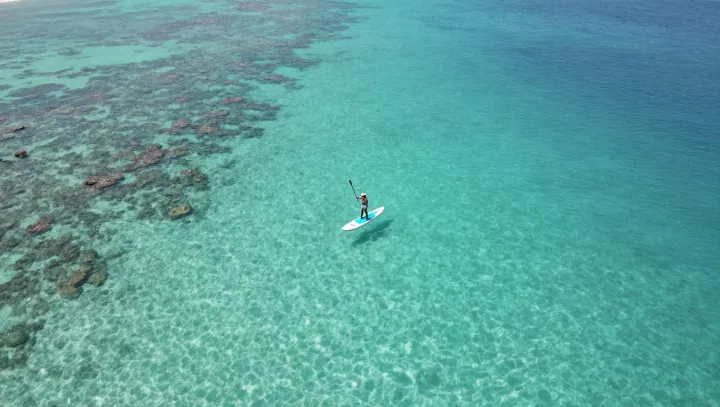
A solo board can feel lighter than air. Not because its mass changes, but because the water around it suddenly stops fighting back when your stroke rate locks onto its natural glide speed. At that point the hull sits in a narrow band of flow conditions where added power no longer produces a matching rise in hydrodynamic drag.
The counterintuitive part is simple. You are not accelerating much anymore. Instead, you are feeding just enough impulse each stroke to replace viscous losses and a thin band of wave-making resistance. Fluid dynamicists would call this operating near a local minimum of the drag–speed curve, where boundary layer behavior stays mostly attached and wave formation remains modest for that hull length.
Below that band, the board feels heavy. Every stroke dumps energy into spin-up, then it dies away as pressure drag and surface friction claw the speed back down. Above it, the water turns hostile as wave drag and turbulent eddies ramp sharply, so each extra bit of speed costs disproportionate effort. Only inside the band does the sensation flip from hauling to balancing.
What paddlers describe as the board “running free” is really phase alignment. Your muscle impulses, the board’s inertia, and the water’s resistance fall into a repeating cycle where momentum carries most of the load and your stroke just tops up the system instead of shoving a stagnant wall of water.