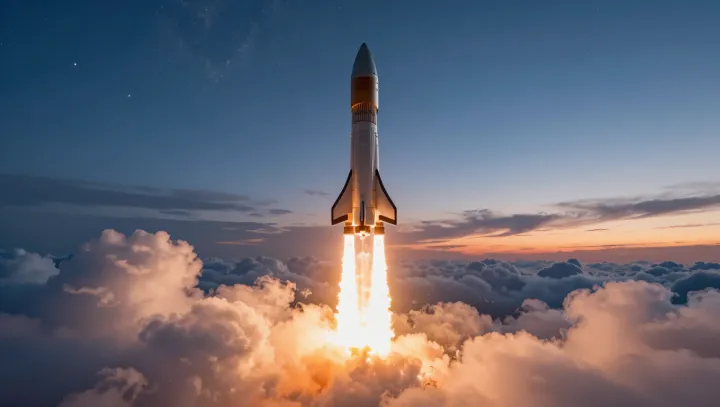
That bright column of flame under a rocket is not a fiery jackhammer on the launchpad at all; it is a high‑speed exit door for mass. The exhaust rushes downward, not to press on the ground, but to carry away momentum so the vehicle can keep the opposite share.
The unpopular truth is that the ground is almost irrelevant. Newton’s third law and conservation of momentum do the real work, because chemical reactions in the combustion chamber raise pressure, and that pressure accelerates exhaust gas through the nozzle to extreme velocity. No brick wall is needed; the wall is the engine itself, as hot gas slams against its interior surfaces while being forced out, and the integrated pressure over the nozzle area produces what engineers call thrust.
Space feels like a problem, yet it is not. No air. No ground. Still works. In the vacuum outside the atmosphere, the same expanding gas pushes on the same metal walls, and the momentum carried away by the exhaust must be balanced by opposite momentum of the rocket body. That is the rocket equation in action, with specific impulse and mass ratio setting how rapidly the craft can change its velocity while it continuously throws mass backward into the dark.