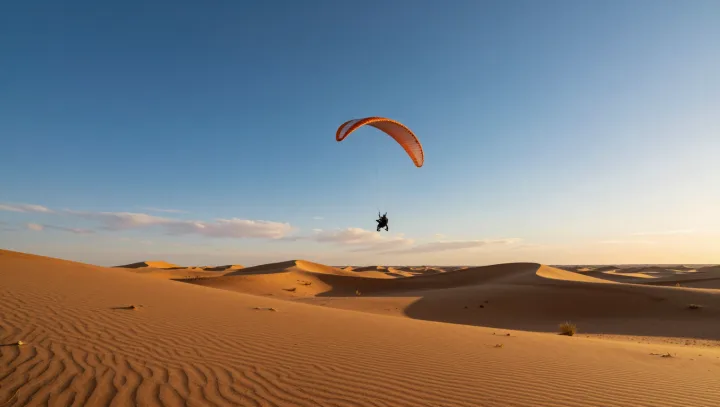
Calm is a lie in desert air. The wing above a paramotor feels a broken, invisible river that the ground cannot show, and three inputs decide whether that river becomes sculpture or threat. Throttle, brake toggles, weight shift: a stripped control suite that hides a surprisingly dense set of aerodynamics and pilot workload.
Precision begins with engine thrust, not with the hands. More throttle increases propeller slipstream and airspeed, loading the wing so its angle of attack stabilizes against gusts and thermal surges. Less power does the opposite, letting the fabric breathe and surge in rising columns. Short pulses of throttle, measured in seconds, map directly to climb rate and sink, turning vertical motion into something almost quantized rather than vague.
Authority over heading is far less gentle than it looks from below. Brake toggles deform the trailing edge, changing local camber and inducing roll and yaw through asymmetric lift and induced drag. A few centimeters too much input and the wing nears stall speed on one side, yet tiny, rhythmic taps can carve a clean line through shear layers that would twist a rigid aircraft. Weight shift then adds a second axis of control: moving the pilot’s mass across the harness shifts the combined center of gravity, generating roll without overusing the brakes, preserving energy and wing pressurization.
What appears effortless is actually continuous micro-correction. Pilots read brake pressure, riser tension, and subtle yaw as real time telemetry, integrating them with cues from the variometer and GPS track. Each twitch of desert turbulence is translated into a specific adjustment of thrust vector and wing loading, so that from the ground, the flight looks serene while, in the air, three simple inputs are running a tight, silent negotiation with chaos.