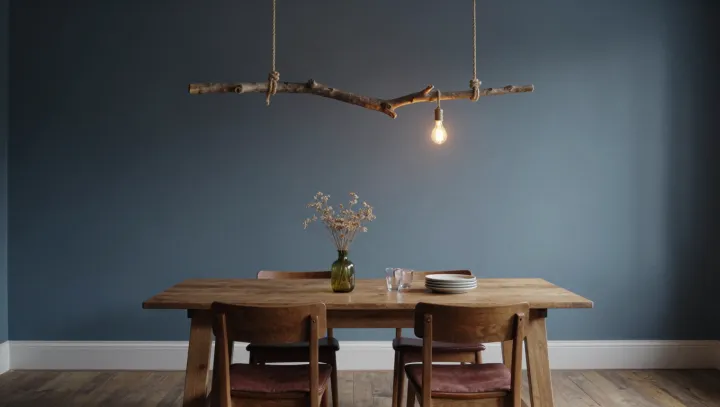
A branch hangs above the table, its bulbs casting a lattice of shadows against a deep blue wall. The effect is more than decoration: where the light falls can make the dining room feel enclosed around its wooden furniture or open beyond it. The branch sets the terms.
Intimacy begins with restraint. When bulbs direct their light downward, the tabletop becomes the brightest surface, while chairs and walls recede into softer shadow. Diners are drawn toward the shared pool of light rather than the room's edges. A dimmer can deepen that effect, though too little light makes it harder to see food and faces. Bulb placement matters just as much: exposed bulbs at eye level can cause glare, breaking the quiet mood the fixture is meant to create. A shade or a careful adjustment can help.
A room can also borrow space from its walls. Light directed outward or upward reveals more of their surfaces and the ceiling, making the boundaries easier to read; the dark blue wall supplies contrast without necessarily disappearing. Shadow projection changes with distance: a branch close to a lit surface tends to cast a sharper shadow, while a larger light source generally produces softer edges. The most useful arrangement allows both effects, with separate ambient lighting available when the table needs company. Above the wood, the branch holds its place between a circle of warmth and the room beyond.