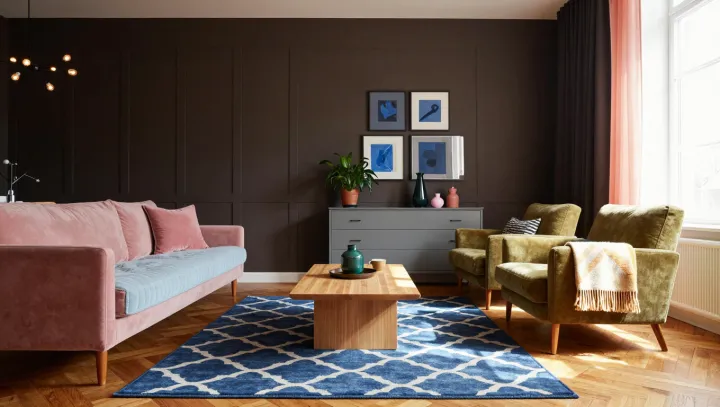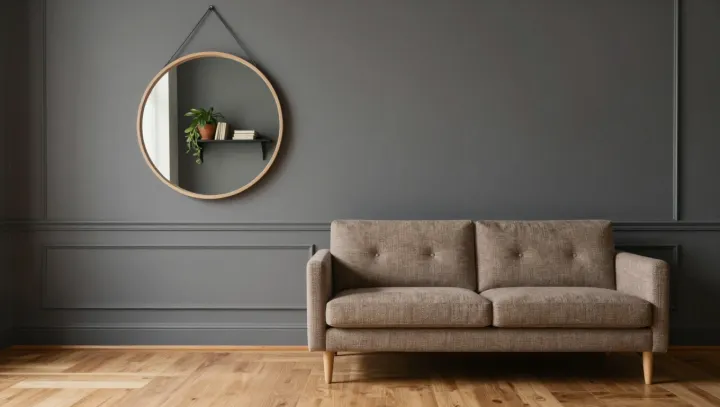
Balance does not require matching sides. In this living room, dark wall molding gives the eye a steady framework, while a round mirror and warm wood introduce shapes and tones that need not be repeated in pairs. The result feels composed rather than rigid. That distinction matters.
Visual weight, not symmetry, is doing the work. A dark surface generally draws more attention than a pale one, while a large object can hold its own against several smaller pieces. Position matters too: an object placed farther from the apparent center of a room can feel more influential than one close to it. Designers call this asymmetrical balance, a way of distributing emphasis without making either side a copy of the other. The mirror helps by offering a distinct circular shape against the straight lines of the molding; its reflective surface can also make the wall feel less visually heavy.
Restraint is more useful than a formula. When furniture and artwork differ in size or placement, their colors, shapes and spacing can still give the eye reasons to travel across the room rather than settle on one crowded corner. Warm wood can soften the contrast of dark walls, while open space gives prominent pieces room to register. There is no need to add an identical object whenever one side feels empty; shifting a piece or leaving breathing room may be enough. In a room that refuses the neatness of a mirror image, the eye finds another kind of order.