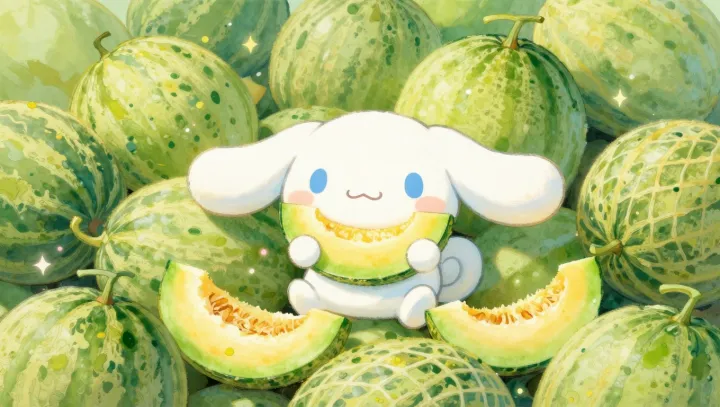
Cinnamoroll's unlikely ears are the secret to his appeal. They suggest a rabbit, yet belong to a white puppy with blue eyes who can fly by flapping them. In an image surrounded by green melons, he holds a slice of fruit, his soft shape set against the vivid color.
The ambiguity does useful work. A character designer can use silhouette, the outline recognized before finer details, to make a figure stand apart; Cinnamoroll's ears stretch that outline far beyond the familiar shape of a puppy. They also give his flight a visual explanation, even if the motion belongs to fantasy rather than physics. The ears do double duty. They distinguish him at rest and supply a means of movement when the story calls for it.
The melon setting sharpens the contrast. Against the fruit's green surfaces, the puppy's white body and blue eyes remain easy to pick out, while the slice in his paws gives the scene a small, readable action. Anthropomorphism adds another layer: a puppy holding food as a person might becomes a companion rather than simply an animal. The picture need not settle the rabbit question. Its charm rests in the space between what the ears seem to promise and what the little flying puppy turns out to be.