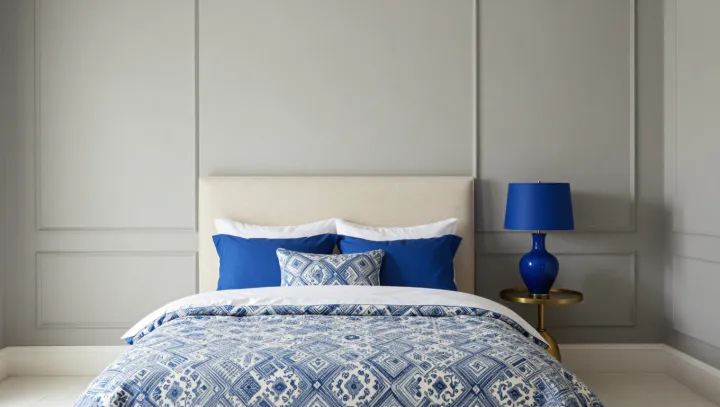
Blue and white is not one palette but two. By daylight, layered bedding can look cool and sharply defined; under a bedside lamp, the same whites may turn creamy and the blues more muted. The difference is not a flaw in the fabric. Light changes the colors available for the eye to see.
A bulb deserves as much scrutiny as a paint sample. Its color temperature, measured in kelvins, describes whether its light appears warm or cool; its spectral power distribution describes how much light it emits at different wavelengths. Materials reflect some wavelengths more than others, so a warm lamp can make white bedding look yellowish and shift the appearance of blue. Color rendering matters too. A bulb with a high color rendering index generally reveals colors more faithfully than one with a low rating, though two bulbs with similar ratings can still make a particular fabric look different.
The safest palette is one tested in the room, not chosen under shop lights. Place fabric and paint samples beside the padded headboard, then examine them in daylight and with the intended bedside bulb switched on. Look at the layers together. A softened white can bridge a pale blue coverlet and a deeper blue throw, while texture gives the bed depth without demanding another color. If the lamp makes a favorite blue look dull, try a different bulb before replacing the bedding. At night, the room should feel less like a daylight photograph than a place willing to change its mood.