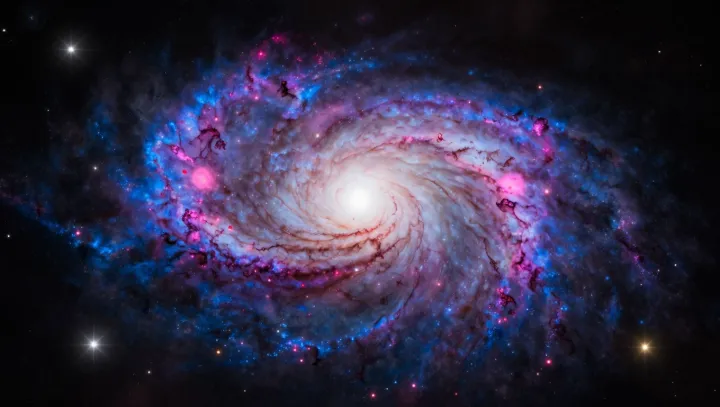
A spiral arm is not a rope of stars being twisted around a galactic center. That distinction solves the apparent knot. In a spiral galaxy, stars at different distances take different amounts of time to complete an orbit; if the arms consisted of the same stars forever, they would wind up tightly.
The more useful picture is a pattern through which matter moves. In density wave theory, gravity sustains regions of slightly greater density that travel around a galaxy at a different rate from many of its stars. Stars enter and leave these crowded regions, much as cars pass through a slow patch of traffic. Gas responds differently. As it encounters a denser region, it can compress, encouraging clouds to collapse and form stars. Short-lived, massive stars shine brightly before they travel far from their birthplaces, helping make the arms visible.
That elegant explanation is not the whole story. Simulations and observations suggest that some spiral arms are transient structures, formed and reshaped by gravitational interactions among stars, gas and nearby galaxies, rather than enduring waves with a single pattern speed. Differential rotation can stretch these features before others take their place. Dust also shapes the view, obscuring starlight in dark lanes while hot young stars lend parts of the arms their blue light. The brilliant spiral is not a permanent arrangement of individual stars, but a changing pattern written across their journeys.