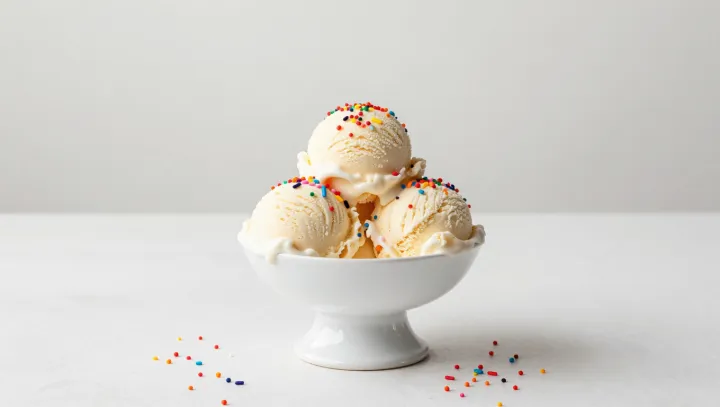
Ice cream is not meant to freeze solid. Beneath the rainbow sprinkles and the colorful bowl lies a carefully managed contradiction: a dessert cold enough to contain ice, yet soft enough to surrender to a scoop. Its secret is not one ingredient, but a structure built from sugar, fat, air and water.
Sugar does more than sweeten. Dissolved in water, it causes freezing point depression, lowering the temperature at which ice begins to form. As ice crystals grow, they leave sugar behind in the remaining liquid, making that liquid more concentrated and harder to freeze. Even below the freezing point of plain water, some liquid remains between the crystals. Temperature still matters: in a sufficiently cold freezer, much more water freezes and the dessert becomes difficult to scoop. The size of those crystals matters too. Small ones feel smooth; larger ones make each bite coarse and icy.
Fat and air earn their place. During churning, some fat droplets partly join together, helping stabilize the air bubbles incorporated into the mixture. Those bubbles make ice cream lighter and reduce the amount of frozen material packed into each spoonful, while fat contributes richness and a creamy sensation. Too much air can leave a scoop insubstantial; too little can make it dense and heavy. Repeated warming and refreezing can also encourage ice crystals to grow, eroding the smoothness that careful freezing created. The sprinkles add color and crunch, but they do not solve the deeper problem. In that bright bowl, softness remains a temporary arrangement between cold and resistance.