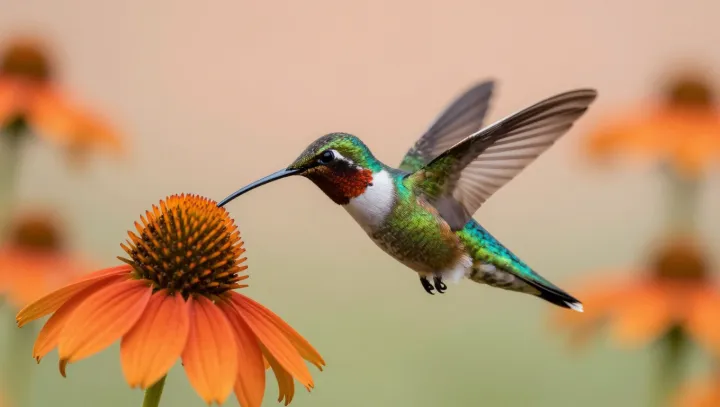
A hovering hummingbird is less like an ordinary bird than its feathers suggest. Its wings produce lift on both the downstroke and the upstroke, allowing it to hold position beside a flower while its bill reaches for nectar. The trick is not simply speed. It is control.
The wing's return journey does more work than a bird watcher might expect. At the shoulder joint, the hummingbird rotates its wing so that the aerodynamic angle of attack remains useful as the direction of travel reverses. Air is deflected downward on both strokes, generating lift that supports the bird's weight. The strokes are not equals. The downstroke generally produces more lift, while the upstroke makes a smaller contribution. Most birds, by contrast, generate much of their lift on the downstroke and reduce drag as their wings rise.
The resemblance to insects is real, but it has limits. Like hovering insects, hummingbirds sweep and rotate their wings through the air rather than relying on a power stroke followed by a largely passive recovery. Yet their anatomy and the balance of forces differ; a hummingbird has not become an insect with feathers. Hovering also carries a steep metabolic cost, which helps explain the importance of energy-rich nectar. Beside the flower, the bird appears almost motionless, suspended by wings that never rest.