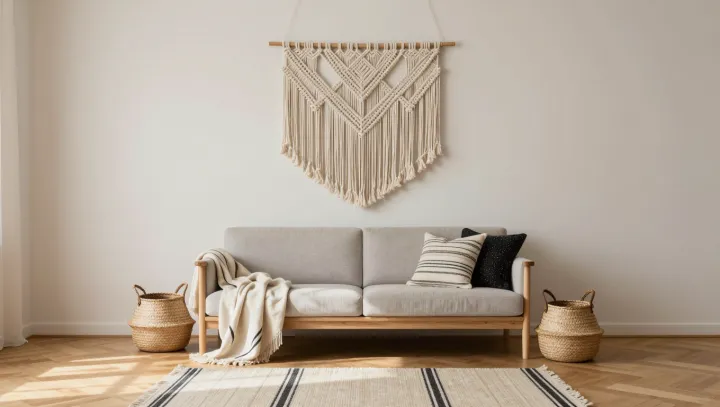
A neutral living room needs tension, not more color. Here, upholstery provides a calm foundation while a macrame wall hanging, woven baskets and patterned textiles interrupt its smoothness. The effect depends less on the number of objects than on how their surfaces meet: soft against coarse, flat against knotted, quiet against patterned.
Texture is the room's real source of variety. Knotted fibers cast small shadows across the wall, and the irregular surfaces of baskets catch light differently from upholstery. Patterned textiles add another scale of detail, giving the eye something to follow without demanding a bright palette. Light does the rest. Daylight falling from the side can make raised fibers more visible; flatter illumination may soften those differences. Designers describe one part of this effect as luminance contrast: the difference in perceived brightness between neighboring areas. Even two materials of similar color can appear distinct when one reflects more light than the other.
Restraint matters as much as accumulation. Too many similarly sized patterns can compete, while an uninterrupted field of pale fabric can leave the room feeling inert. A basket beside a sofa, or a cushion against plain upholstery, creates contrast through proximity rather than color. Leave breathing room. The wall hanging can then read as a focal point instead of another item in a crowded arrangement. In this room, richness resides not in an inventory of possessions but in the changing line between a woven fiber and its shadow.