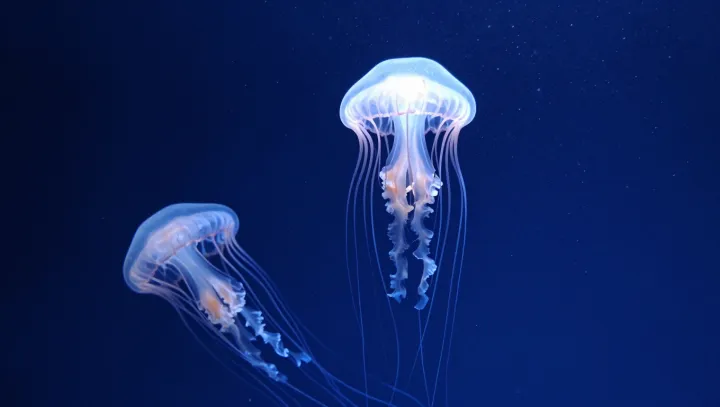
A jellyfish needs no brain to swim with purpose. Its translucent bell contracts, pushing water backward as tentacles trail behind, armed with stinging cells. The movement is not directed from a command center. Instead, signals pass through networks of neurons distributed across its body.
Distributed control is less primitive than it looks. In many jellyfish, nerve nets carry signals that coordinate contractions of muscles around the bell; rhythmic activity from pacemaker regions helps set the swimming pulse. Sensory structures called rhopalia, found in many species, can detect orientation and, in some cases, light. That information can alter swimming, helping an animal respond to gravity or changes in illumination. A pulse is not a plan. Yet the result can be a coordinated response to a shifting environment, without the centralized circuitry familiar from vertebrates.
The trailing tentacles are more than decoration. Their stinging cells contain nematocysts, microscopic capsules that discharge a thread when triggered, helping immobilize prey and discourage predators. Captured food can then be moved toward the mouth, while the bell keeps pulsing through the water. Species differ in their sensory equipment and behavior, so no single arrangement explains every jellyfish. Some are capable of more complex responses than their drifting appearance suggests. Beneath the clear bell lies a quiet challenge to the notion that every coherent movement must begin with a brain.