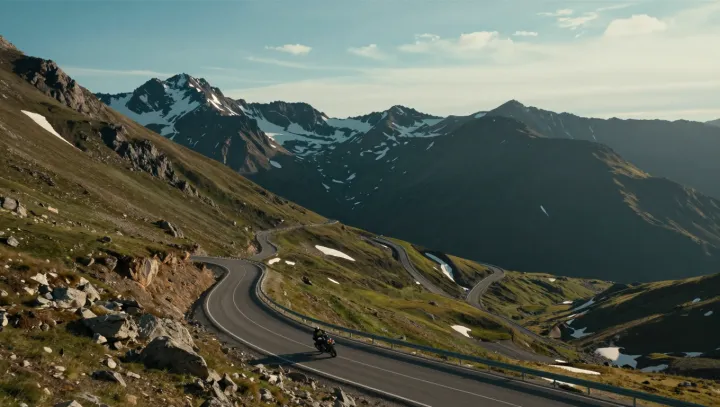
The asphalt ribbon climbing one of Switzerland’s most feared passes no longer behaves like a trap; it functions like a safety device. Every tight hairpin, every abrupt bend, is tuned to make drivers do the one thing crash data keeps demanding: slow down early and predictably.
Engineers began by treating the pass as a dynamic system rather than a static road, running vehicle dynamics models that balance centrifugal force against friction and tire slip angle. Instead of smoothing the curves, they sharpened and regularized them, setting a consistent minimum radius and coordinated sequence so drivers anticipate a rhythm, not random shocks. Superelevation, the deliberate banking of each curve, is calibrated to counter lateral acceleration without inviting higher speeds on the straights.
Guardrails, rock cuts, and even voids are arranged to manage human perception as carefully as mechanical load. Sightlines are opened before each hairpin to increase preview time, exploiting basic reaction time and hazard perception research rather than betting on driver skill. Lane widths tighten slightly near the most extreme bends, raising perceived risk just enough to trigger instinctive speed reduction while still meeting standards for heavy vehicles. Runoff zones and impact-absorbing barriers close the feedback loop, turning what was once a place of abrupt entropy increases in traffic flow into a controlled cascade of energy dissipation.